
One of Turkey's most comprehensive microalgae production farms is being established at MAKÜ
Yapılış Tarihi | 23 June 2026, Tuesday

Burdur Mehmet Akif Ersoy University (MAKÜ) is preparing to establish a microalgae production farm by adding another project to its studies in the field of biotechnology. The facility, where microalgae used in many sectors, primarily food, livestock, pharmaceutical industry, and environmental applications, will be produced, aims to contribute to reducing Turkey's dependence on foreign sources in this field.
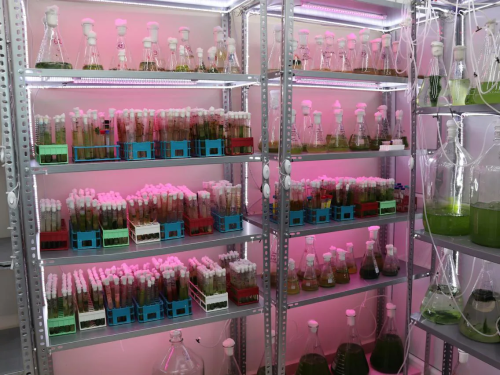
Supported by the Presidency of Strategy and Budget and the Higher Education Council, the university continues its work within the framework of the MAKÜ Regional Development-Oriented Mission Differentiation and Specialization Program, under the project “An Innovative Food and Feed Additive Source: Microalgae.” The university draws attention with its Microalgae Biomass Production Laboratory.
Assoc. Prof. Dr. Füsun Akgül, a faculty member of the Department of Molecular Biology and Genetics at MAKÜ Faculty of Arts and Sciences, who is leading the project, stated that feed additives for poultry are produced in the laboratory, and the production of “MAKÜ Spirulina,” which is a dietary supplement, is also ongoing.
Emphasizing that microalgae are extremely valuable organisms from a biotechnological perspective, Assoc. Prof. Dr. Akgül expressed that these organisms have significant potential for use in various fields, including food and feed sectors, wastewater treatment, carbon removal, and the pharmaceutical industry.
“aLgaç” can capture as much carbon dioxide as five 25-year-old trees in one day
As part of the studies conducted at MAKÜ, the AlgBe Biotechnology Company, which operates within the MAKÜ BAKA Technopolis, has also developed an innovative system for carbon capture in line with the European Union's Green Deal targets. Assoc. Prof. Dr. Füsun Akgül stated that the photobioreactor named “aLgaç” is designed as an alternative carbon sink and also provides microalgal biomass production.
Assoc. Prof. Dr. Akgül reported that according to their calculations, “aLgaç” can capture as much carbon dioxide as five 25-year-old trees in one day, and the biomass obtained can also be evaluated as biofertilizer. She noted that the product, developed as a completely closed and controlled system, operates with solar energy and is designed to be used in cities with high traffic and industrial density, as well as in areas such as hospitals, schools, and airports. A patent application has also been made for the system.
Planned to open in September
Assoc. Prof. Dr. Füsun Akgül mentioned that the studies in the field of microalgal biotechnology have attracted the interest of investors and announced that a new microalgae production farm will be established with the investment support provided within the MAKÜ BAKA Technopolis.
Assoc. Prof. Dr. Akgül stated that the facility to be established will be one of Turkey's most comprehensive microalgae production farms at European standards and mentioned that the farm is planned to become operational in September. It is aimed to offer microalgae-based products to both the domestic market and for export.
Pointing out that Turkey is largely dependent on foreign sources for microalgae-based products, Assoc. Prof. Dr. Füsun Akgül noted that the established farm aims to reduce this dependency, prevent foreign currency loss, and increase domestic production capacity. Assoc. Prof. Dr. Akgül also stated that young researchers are actively involved in the project, emphasizing that the work is not only a laboratory investment but also aims to create a microalgae biotechnology platform.
In a brief evaluation on the subject, Rector Prof. Dr. Hüseyin Dalgar stated, “As Burdur Mehmet Akif Ersoy University, we are taking another important step in transforming our identity as a specialized university into economic value through scientific production. I believe that this scientific production rising from Burdur will contribute to our country's future goals in the fields of food, livestock, environment, and biotechnology.
I congratulate all our academics and researchers, especially our project leader Assoc. Prof. Dr. Füsun Akgül, who contributed to this valuable work, and I thank our supporting stakeholders.”
Strong microalgae collection at MAKÜ
The Microalgae Culture Collection (MAKUMACC) established within MAKÜ also constitutes one of the important pillars of the studies in the field. Prof. Dr. Rıza Akgül, a faculty member of the Food, Agriculture, and Livestock Vocational School, stated that the microalgae isolated and purified in the collection are cultured and evaluated in various biotechnological applications.
Prof. Dr. Rıza Akgül noted that researchers can obtain unialgal microalgae species through MAKUMACC, stating that the collection consists of 150 species and strains, making it one of the most comprehensive microalgae culture collections in Turkey. It was also reported that MAKUMACC is among the members of the World Culture Collections Federation.